

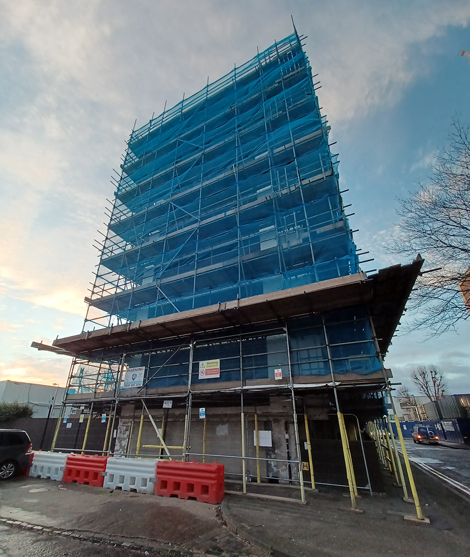
We launched our cladding remediation programme following the Grenfell Tower tragedy and a recognised need across the housing industry to improve building safety. There has been lots of discussion about cladding in the news, so we’ve brought everything together here to explain what we’re doing and what it means for you.
What is the programme about?
Our cladding remediation programme finds and fixes unsafe external wall systems, often called cladding. When we identify a building’s wall system is made up of combustible materials, it’s added to our programme. We’ll then remove the combustible material to reduce the risk of fire and ensure the building is structurally safe. Some buildings may need only minor works while others may be more extensive. The programme is prioritised with issues that have been deemed higher-risk being completed first.
What is the PAS Programme?
Our PAS Programme is how we prioritise and assess external wall systems in line with the PAS 9980 standard and current government fire safety guidance.
Each building goes through staged checks - site investigations, engineering analysis and independent review- to understand how the external walls are built and whether any interim safety measures or remediation are needed. Leaseholders will not be charged for PAS Assessments.
What we do
We appoint specialist fire engineering consultants to carry out the assessment. Their work includes:
- Visiting the building and opening parts of the external wall at different locations and heights
- Using access equipment to inspect multiple sections of the façade
- Requesting access to selected balconies where needed.
Their aim is to confirm exactly how the wall system has been constructed and whether it meets safety expectations.
After the investigation
When site investigations are complete, the consultant prepares a PAS 9980 report with their findings and a risk rating. An independent fire engineer then reviews the report to confirm whether additional safety measures or changes to the building’s fire safety management are required.
We share the outcome with residents. From the end of investigations to the final outcome typically takes 16-20 weeks.
If defects are found
If remediation is needed, the independent fire engineer will advise whether the evacuation strategy must be updated during the works.
We'll then plan and schedule the necessary remediation as efficiently as possible. Our programme is reviewed regularly to ensure it aligns with government expectations and reflects what we learn as assessments continue across all buildings.
Mortgage lenders are increasingly querying the make-up of external walls on buildings. These queries cover all building types and not just those with cladded materials on the exterior. Many mortgage providers are currently asking for additional information about a building’s external wall system in an EWS1 form before they are willing to lend against it. EWS stands for external wall system.
In order to complete an EWS1 form, a suitably qualified professional must conduct a fire safety assessment and confirm their findings on the form. The form will help ensure information relating to the assessment of external wall systems is recorded consistently. The aim of the form is to deliver assurance on the construction of a building’s external wall for lenders and their valuers.
Only one assessment and form is required for each building and, currently, these will be valid for five years. If you’d like to know more, there are some FAQs at the bottom of this page.

Diagram shows: If a PAS assessment is carried out and remediation is required it will be added to the programme. If remediation is identified as not being required, an EWS1 form will need to be completed.
What has been done so far?
We're working through a long-term programme, currently we:
- Have completed work on 17 buildings
- Are working on, or preparing to start work on around 40 buildings
- Have identified around 350 buildings that need some level of remediation, though this number may change as we continue our assessments.
How we'll communicate with you
We know that building safety work can feel disruptive, and clear, consistent communication is essential. Throughout works, we’ll keep you fully informed, involved, and supported at every stage. Our communications approach follows a structured plan developed jointly with our contractor, ensuring that updates are timely, accessible, and easy to understand. If you'd like to provide any feedback on our communication with you, you can do so by emailing hello@southernhousing.org.uk.
What you can expect
- Monthly newsletters summarising key progress, upcoming activity, site management, community project initiatives, and any changes that may affect day-to-day living.
- We’ll send you a tailored communication plan to make sure you know what’s happening, why and what to expect. In line with our Building Safety Resident Engagement Strategy, we’ll engage with you throughout the programme and seek your feedback once it’s complete.
- A ‘meet the contractor’ session before major works begin, giving you the chance to hear directly from the project team and ask questions.
- A design meeting, to walk you through the design and technical approach before construction starts, with presentation materials available afterwards.
- Monthly online resident meetings, providing a consistent forum to ask questions, raise concerns, and hear progress updates from the project team.
- Resident information packs available in communal areas or distributed at meetings. These will include details on the works, why they’re needed, timelines, FAQs, and links to the microsite and surveys.
- Key materials - including meeting slides, notices, and safety information - will also be displayed in communal areas, where possible.
- If you want any information in a different format, let us by either email hello@southernhousing.org.uk or calling 0300 303 1066 if you’re a tenant, or 0300 555 2171 if you’re a home owner.
We’re committed to providing clear, transparent, and consistent communication throughout the works. Whether through in person events, monthly updates, online information, or direct engagement, we want you to feel informed, listened to, and confident about work taking place in and around your home.

Working with partners
We’ve partnered with Equans to deliver much of our remediation work. To speed things up and increase our capacity, we’re also introducing a new delivery model where we’ll bring in more contractors, including AD Construction and Amber Construction.
Frequently asked questions (FAQs)
We know you may have questions about cladding, building safety and how decisions are made. We’ve included some FAQs on this page so you can find answers quickly.
Costs and charges
We’ve long called for clarity from the Government around who should pay for fire remediation costs. We welcome the Government announcement that leaseholders shouldn’t have to pay, along with further detail about recovering costs from developers. And we’re glad these commitments carry the full force of law, following the introduction of the Building Safety Act 2022.
We’re pleased to confirm we’ve updated our policy to reflect the new Government position. We won't pass on costs to leaseholders for:
- Any fire safety remediation works we undertake related to historic defects as defined by the Building Safety Act 2022
- Work carried out relating to interim measures - this includes temporary alarm installations and evacuation management costs (such as Waking Watch).
This applies to all leaseholders*, irrespective of the height of the building you’re living in.
*This may not apply if you’re a buy to let investor or if you own more than three properties.
Leaseholder recharging for day-to-day costs and maintenance works will continue as normal. This will include day-to-day fire safety costs, which have always been charged to leaseholders, such as the maintenance of safety equipment and regular inspections.
We’re an active member of the National Housing Federation, which is meeting regularly with UK Cladding Action and other leaseholder groups on behalf of all housing associations.
Yes, we’re continuing our efforts to pursue developers, warranty providers and other third parties for costs. This may impact on the speed at which your building will have any required works completed.
As a not-for-profit organisation, we’re under an obligation to protect our charitable aims. We reinvest our income back into providing services for our 90,000+ residents, so it’s vital we do all we can to reduce the financial impact of meeting these fire safety costs on our wider work.
We will cover this cost and can confirm it will not be recharged to leaseholders.
We’ve set aside significant funds to spend on fire safety works over the next five years. Unlike private developers, we’re a not-for-profit organisation and we reinvest our income back into providing services for our 90,000+ residents. While we’re not offering compensation to individual households, we will be protecting our leaseholders from costs as set out on this web page.
We won’t charge leaseholders for any fire safety remediation works related to historic defects as defined by the Building Safety Act 2022. This applies to all our shared owners and leaseholders.
To clarify, this applies to all leaseholders*, irrespective of the height of the building you’re living in. We will vigorously continue our efforts to pursue developers, warranty providers and other third parties for costs.
*This may not apply if you’re a buy to let investor or if you own more than three properties.
My flat and building
We hope the measures the Government have introduced will mean leaseholders will be able to sell their homes again without difficulty. However, we have no control over a lender’s decision around lending against your home.
We’re reliant on the Government putting pressure on lenders to lend against these buildings. Although we have no direct control over this, we’ll continue to lobby Government on your behalf. In the meantime, we’ll do all we can to support you and would encourage you to speak to us about your options. We’re happy to discuss things on a case-by-case basis.
As we’ve explained, the national shortage of qualified assessors means we’re unable to give a firm date at the moment for the start of works in particular blocks. We’ll let leaseholders know when their building has been reassessed and discuss the details of any works that are needed on a case-by-case basis. We can reassure you we’re doing everything we can to keep this process moving. We’ll continue to maintain interim fire safety measures, where necessary, to ensure your safety.
We want to make sure you’re safe in the building you live in. This has always been our number one priority.
Since the Grenfell tragedy in June 2017, we’ve complied with the Government’s changing advice and guidance around building safety.
To assess which buildings required works, we’d previously followed the MHCLG’s (Ministry of Housing, Communities and Local Government) “Advice for Building Owners of Multi-storey, Multi-occupied Residential Buildings” [January 2020], and the subsequent ‘Supplementary note to building safety advice for building owners’ [November 2020].
This guidance was officially withdrawn in January 2022 and replaced with PAS 9980. PAS 9980 is a new code of practice for the fire risk appraisal of external wall construction and cladding of existing multistorey and multi-occupied residential buildings. We’re now using this new guidance to determine whether works are needed.
We’re keen to ensure we have up-to-date fire safety assessments, using the new PAS 9980 code of practice.
The national shortage of qualified assessors makes this incredibly challenging, but we’re conducting PAS 9980 assessments as quickly as we’re able. Once we’ve completed the assessment we’ll share the findings with you and explain what this means for your building.
We’ll be following the requirements set out in the Government’s PAS 9980 guidance. This may mean the same work is still required at your building, some work is needed or work is no longer required at all.
While assessments are ongoing, we’ll continue to maintain interim fire safety measures, where necessary, to ensure your safety. We’ll cover the cost of these arrangements. Our approach to fire safety will remain proportionate and we’ll only carry out works where they’re reasonably required.
Waking Watch:
A Waking Watch is a short-term measure for buildings which are referred to as ‘high risk’. It’s a service where operatives regularly patrol the building within set periods of time.
A Waking Watch would remain in place whilst temporary measures, such as temporary alarms, are installed. The operatives also manage the evacuation and liaise with the fire service in the event of a fire.
Waking Watch generally only applies to buildings over 18m, though it may be considered necessary for buildings under 18m.
Evacuation Marshal:
Evacuation Marshals provide an ongoing presence in the highest risk buildings (generally only buildings over 18m) following the installation of the interim measures, such as the temporary alarm. They co-ordinate and manage the evacuation of the building and liaise with the fire service in the event of a fire.
Evacuation Steward:
An Evacuation Steward provides evacuation management to a resident who is otherwise unable to self-evacuate. Residents are identified as requiring an Evacuation Steward through a formal person-centred fire risk assessment and personal emergency evacuation plan.
Evacuation Stewards can be required in any building where the evacuation strategy has been changed to self-evacuation and where there is a resident who’s unable to appropriately self-evacuate.
We're committed to being open about building safety. However, we don't usually share full specialist or contractor reports.
These reports are written for professionals and often include technical, commercially sensitive, or security-related information that may not be suitable to share in full.
Instead, we provide clear summaries that explain the key findings, any risks, and what actions we are taking. This ensures you receive the most important information in a way that is easy to understand.
If you've any questions or would like more detail, please contact us and we'll be happy to help.
We want to be as open and transparent as we can be with you. We understand why it might be frustrating not being able to see every document. We use documents to support our legal claims. Upon request we can provide you with a summary of information.
Wellbeing
We’re really sorry you’re having to go through this. This is a situation many other residents across the country are facing too.
Our staff are empathetic to the situation you’re in.
You’re not alone. If you’re feeling stressed or are struggling, please talk to us and we can signpost you to support services. The NHS has lots of useful resources, while the Samaritans and Mind may prove helpful too.
Information for homeowners
If you’re planning to change your mortgage, are thinking of selling, or want to buy more shares in your home, you need to consider that many lenders have now made changes to their conditions.
We’ve a phased testing programme for our high-rise buildings. We’ve employed Fire Engineers to carry out the testing. This will involve surveys of the construction of the external wall system and highlighting if there’s any need for remediation works. In most instances, this will involve intrusive testing by ‘opening up’ the building and testing all the materials used in its construction to ensure they meet the new guidance. We’re also asking our Fire Engineers to complete an EWS1 Form for the building.
Due to the high level of demand for the services of a small pool of suitably qualified experts, it will take time for these surveys to be completed. We anticipate it will take several years to deliver the programme of testing and complete the remediation work.
We complete regular Fire Risk Assessments for our apartment blocks, and complete any recommendations from the assessor built as part of the action plan for the building. You can request a copy of the Fire Risk Assessment by contacting us.
The latest Government advice is lenders shouldn't ask for EWS1 forms on buildings below 18 metres.
We welcome the announcement by the Secretary of State for Housing that government will encourage lenders to take a more proportionate approach to EWS1 forms.
Through our lobbying work with the G15 group of housing associations, we’ve been pushing for a more proportionate approach for fire safety for some time. We’re really pleased to see government responding to these calls.
We know our leaseholders will have questions about what this news means for remediation works in their home. We’ve asked our independent fire safety engineers what impact this change will have on Southern Housing's fire safety programme.
We’re also waiting for more detailed guidance from government.
Once we’ve reviewed the details behind this announcement, we’ll provide a further update.
If there have been no material changes to the external wall system since the original assessment, we won’t be carrying out a new assessment. If there has been a material change to your external wall system, or new information comes to light which changes our view of your building's external wall risk, we’ll review our position accordingly.
We’re aware of the recently revised PAS 9980:2026 and are currently reviewing what the new standard means for our external wall assessment arrangements and wider portfolio. The revised standard doesn’t mean that every building needs a new assessment. If further assessment is needed, we'll review this based on the level of risk. We’ll consider the building’s construction, its external wall system, any assessments already completed and relevant fire risk information.
In these cases, Southern Housing may not be responsible for the exterior of the building. We’re in regular contact with freeholders and managing agents for these buildings, and are encouraging them to complete testing and produce EWS1 Forms.
We’re finding most mortgage lenders are requesting an EWS1 Form before signing off a mortgage. However, some lenders may accept a FRAEW (Fire Risk Appraisal of External Walls) if available. Many lenders are finding this document more informative than the EWS1.
Depending on where you live, this may mean you’re not able to staircase, re-mortgage or sell your home at the current time.
However, not all mortgage lenders are applying the same criteria so it is worth shopping around. This issue is unlikely to affect transactions where there is not a mortgage.
We realise this may be difficult news for our homeowners, and are very sorry this could leave you in a difficult position. Together with our partners in the sector, we’re doing everything we can to find a way forward with the Government.
We’re discussing this on a case-by-case basis with homeowners who are currently in the staircasing, remortgaging, or sale process. We’d encourage any homeowner who’s looking to staircase, remortgage, or sell their property to contact us first before incurring any fees for legal or financial advice.
If you need this information in a different format such as a translation or audio version, please find details our our Accessibility page.


